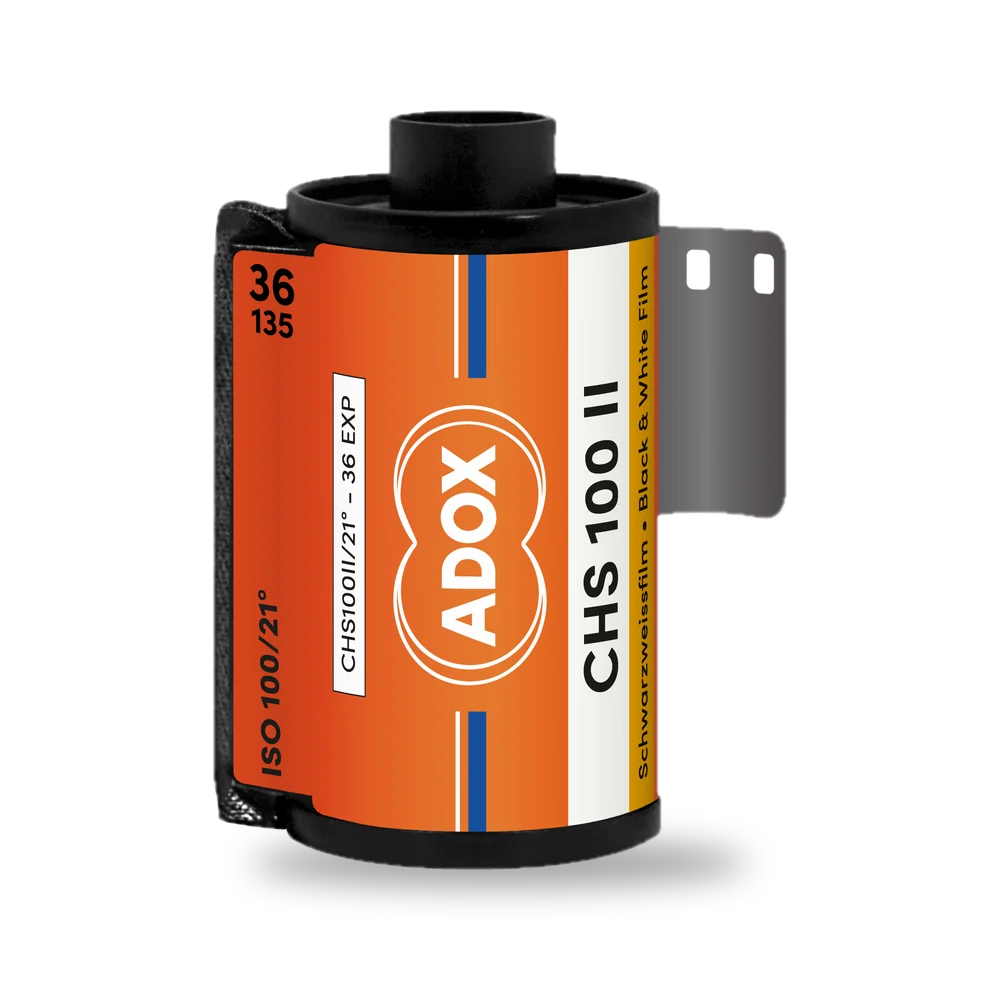
A genuine classic emulsion black-and-white film, and one of the very few still in production. Adox introduced CHS 100 II in 2014 to fill the gap left when Fotokemika in Croatia shut down and took the old Efke emulsions with it — the same emulsions Adox had sold for years as CHS Art. Rather than reviving that exact recipe, Adox developed a new single-layer, silver-rich cubic-grain emulsion coated in Germany, keeping the character of the originals while improving consistency and handling.The single-layer construction is the film's point. Modern emulsions stack several layers of differing sensitivity to build contrast and tame highlights; CHS 100 II doesn't, which gives it a long, unhurried tonal scale, high acutance, and a rendering that reads as mid-century rather than contemporary. Panchromatic with sensitivity extending unusually far into the red. Available in 35mm, 120, and sheet formats, including large and ultra-large sizes.
CHS 100 II
Development times
| Developer | Dilution | EI | Temp | Time | Agitation | Source |
|---|---|---|---|---|---|---|
| Fomadon Excel W27 | stock | 100 | 20.0 °C | 9:00 | — |
Verified
Datasheet
|
| Fomadon LQN | 1+10 | 100 | 20.0 °C | 9:00 | — |
Verified
Datasheet
|
| Fomadon P | stock | 100 | 20.0 °C | 7:00 | — |
Verified
Datasheet
|
| Fomadon R09 | 1+50 | 100 | 20.0 °C | 9:30 | — |
Verified
Datasheet
|
| Rodinal | 1+25 | 100 | 20.0 °C | 5:30 | — |
Unverified
Datasheet
|
| Rodinal | 1+50 | 100 | 20.0 °C | 12:30 | — |
Unverified
Datasheet
|
| D-76 | 1+1 | 100 | 20.0 °C | 9:00 | — |
Unverified
Datasheet
|
| D-76 | stock | 100 | 20.0 °C | 6:30 | — |
Unverified
Datasheet
|
| ID-11 | 1+1 | 100 | 20.0 °C | 7:30 | — |
Unverified
Datasheet
|
| Rodinal | 1+100 | 100 | 20.0 °C | 30:00 | — |
Unverified
Datasheet
|
| FX-39 Type II | 1+9 | 100 | 20.0 °C | 7:30 | — |
Verified
Datasheet
|
| Rodinal | 1+25 | 100 | 20.0 °C | 5:30 | — |
Verified
Datasheet
|
| Rodinal | 1+50 | 100 | 20.0 °C | 12:30 | — |
Verified
Datasheet
|
| Atomal 49 | stock | 100 | 20.0 °C | 6:30 | — |
Verified
Datasheet
|
| Atomal 49 | 1+1 | 100 | 20.0 °C | 10:00 | — |
Verified
Datasheet
|
| FX-39 Type II | 1+19 | 100 | 20.0 °C | 13:00 | — |
Verified
Datasheet
|
| Silvermax Developer | 1+19 | 100 | 20.0 °C | 8:30 | — |
Verified
Datasheet
|
| Ilfotec DD-X | 1+4 | 100 | 20.0 °C | 7:00 | — |
Verified
Datasheet
|
| ID-11 | 1+1 | 100 | 20.0 °C | 7:30 | — |
Verified
Datasheet
|
| D-76 | stock | 100 | 20.0 °C | 6:30 | — |
Verified
Datasheet
|
| D-76 | 1+1 | 100 | 20.0 °C | 9:00 | — |
Verified
Datasheet
|
| HC-110 | Dilution B (1+31) | 100 | 20.0 °C | 5:30 | — |
Verified
Datasheet
|
| HC-110 | Dilution D (1+39) | 100 | 20.0 °C | 7:00 | — |
Verified
Datasheet
|
| HC-110 | Dilution E (1+47) | 100 | 20.0 °C | 9:00 | — |
Verified
Datasheet
|
| XTOL | 1+1 | 100 | 20.0 °C | 8:00 | — |
Verified
Datasheet
|
| HRX | 1+17 | 100 | 20.0 °C | 11:00 | — |
Verified
Datasheet
|
Development times by developer
14 developers
- CHS 100 II in Atomal 49 4
- CHS 100 II in D-76 6
- CHS 100 II in FX-39 Type II 3
- CHS 100 II in Fomadon Excel W27 1
- CHS 100 II in Fomadon LQN 1
- CHS 100 II in Fomadon P 1
- CHS 100 II in Fomadon R09 1
- CHS 100 II in HC-110 6
- CHS 100 II in HRX 1
- CHS 100 II in ID-11 3
- CHS 100 II in Ilfotec DD-X 2
- CHS 100 II in Rodinal 7
- CHS 100 II in Silvermax Developer 4
- CHS 100 II in XTOL 2
Character
Tonality: long, gently rising curve with generous shoulder. Highlights hold on much longer than a modern 100-speed film before blocking up; midtones are where it separates best.
Grain: cubic, clearly visible, sharp-edged rather than mushy. Not fine by modern standards — closer to the look of a 1960s emulsion than to Delta or T-Max.
Sharpness: excellent. The thin single-layer coating gives strong edge definition, which is a large part of why the grain reads as crisp rather than soft.Red sensitivity: extended, so reds and warm skin render lighter than expected and skies go paler without a filter. A yellow or orange filter has a stronger effect here than on most panchromatic films.
Glow: highlights bloom slightly around hard light sources — a characteristic of thin classic emulsions and a large part of why people choose it.
Latitude: wide on the overexposure side, less forgiving under. Many shooters rate it at EI 50–80 to open the shadows.
Developers: Rodinal/Adonal 1+50 is the traditional pairing and emphasises the sharpness and grain. Atomal 49 or D-76/ID-11 tames the grain and gives a softer, more compact scale. XT-3 sits between.
Handling: the emulsion is softer than modern films. Wash and squeegee carefully; avoid hardening-free workflows getting warm, and expect 120 to curl.
Best suited to: landscape, architecture, still life, portraiture in soft light — subjects with long tonal ranges and time to expose carefully. Less suited to fast handheld work or scenes needing clean shadow detail at box speed.
In one line: the closest thing currently in production to what black and white film looked like before multi-layer coating.
Link to this page
Specification
- Base
- PET
- Emulsion
- Hybrid
- Spectral sensitivity
-
Orthochromatic — what this means
Sensitive to blue and green but effectively blind to red. Reds go very dark and blues go light, which is why skin blemishes stand out and skies wash out. The compensation is that it can be handled under a deep red safelight, so you can watch it develop.
- Grain (RMS)
- —
- Resolving power line pairs / mm
- —
- Maximum density
- —
- Latitude over
- —
- Latitude under
- —
- First released
- 2013
A dash means the figure has not been read off a datasheet. Nothing here is estimated.
0 reviews
Written by photographers, under their own profile — so you can see what they shoot before you weigh what they say.
0 comments
Notes on how this behaves in practice — what it does in the field is worth as much as what the datasheet says.
No comments yet. Be the first to say how it actually behaves.