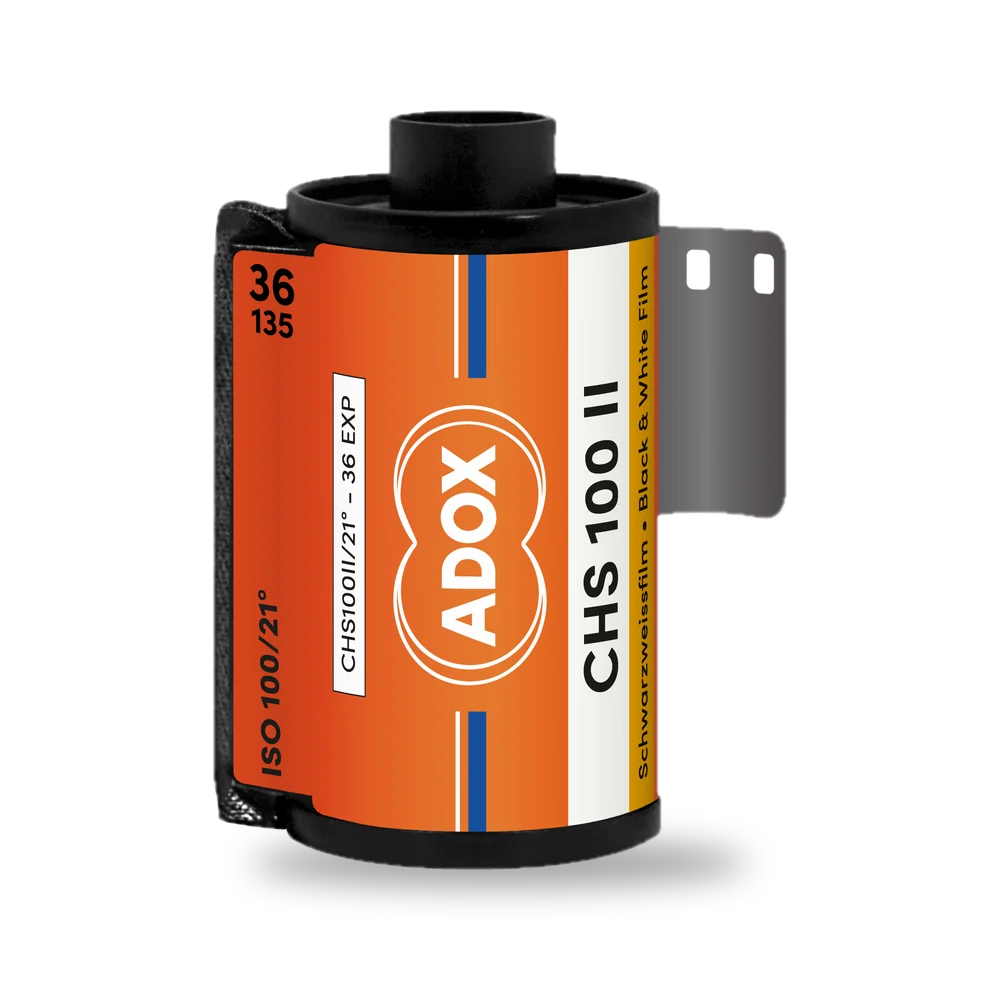
A genuine classic emulsion black-and-white film, and one of the very few still in production. Adox introduced CHS 100 II in 2014 to fill the gap left when Fotokemika in Croatia shut down and took the old Efke emulsions with it — the same emulsions Adox had sold for years as CHS Art. Rather than reviving that exact recipe, Adox developed a new single-layer, silver-rich cubic-grain emulsion coated in Germany, keeping the character of the originals while improving consistency and handling.The single-layer construction is the film's point. Modern emulsions stack several layers of differing sensitivity to build contrast and tame highlights; CHS 100 II doesn't, which gives it a long, unhurried tonal scale, high acutance, and a rendering that reads as mid-century rather than contemporary. Panchromatic with sensitivity extending unusually far into the red. Available in 35mm, 120, and sheet formats, including large and ultra-large sizes.
CHS 100 II
Especificação
Tabela 1- ISO nominal
- 100
- Processo
- P&B
- Status
- Em produção
- Primeiro lançamento
- 2013
- Formatos disponíveis
- não informado
- BaseBase do filme O suporte transparente e flexível que carrega a emulsão. Leia mais no glossário ›
- PET
- EmulsãoEmulsão A camada sensível à luz de um filme: minúsculos cristais de haleto de prata mantidos em gelatina. Leia mais no glossário ›
- Híbrido
- Sensibilidade espectralSensibilidade espectral A quais cores de luz um filme responde, e com que intensidade. Leia mais no glossário ›
-
Ortocromático — o que isso significa
Sensível ao azul e ao verde, mas na prática cego ao vermelho. Os vermelhos ficam muito escuros e os azuis claros, razão pela qual as imperfeições da pele se destacam e os céus se apagam. Em compensação, pode ser manuseado sob uma luz de segurança vermelho-escura, então você pode vê-lo revelar.
- Grão (RMS)Grão A textura visível, parecida com areia, em uma fotografia, que vem dos aglomerados de prata ou corante que formam a imagem. Leia mais no glossário ›
- não informado
- Poder de resolução, pares de linhas / mm
- não informado
- Densidade máximaDensidade O quanto de luz um negativo, transparência ou cópia bloqueia. Leia mais no glossário ›
- não informado
- Latitude para superexposiçãoLatitude de exposição O quanto um filme pode ser super ou subexposto e ainda dar um resultado utilizável. Leia mais no glossário ›
- não informado
- Latitude para subexposição
- não informado
Um traço significa que o valor não foi lido em uma ficha técnica. Nada aqui é estimado.
Tempos de revelação
Abrir na calculadora ›Usado a — sensibilidade nominal marcada
Mostrando 40 de 42 tempos publicados.
| Revelador | Diluição | EI | Temp. | Tempo | Agitação | Fonte |
|---|---|---|---|---|---|---|
| Fomadon Excel W27 | estoque 20,0 °C | 100 | 9:00 | — | ||
| Fomadon LQN | 1+10 20,0 °C | 100 | 9:00 | — | ||
| Fomadon P | estoque 20,0 °C | 100 | 7:00 | — | ||
| Fomadon R09 | 1+50 20,0 °C | 100 | 9:30 | — | ||
| Rodinal | 1+25 20,0 °C | 100 | 5:30 | — | ||
| Rodinal | 1+50 20,0 °C | 100 | 12:30 | — | ||
| D-76 | 1+1 20,0 °C | 100 | 9:00 | — | ||
| D-76 | estoque 20,0 °C | 100 | 6:30 | — | ||
| ID-11 | 1+1 20,0 °C | 100 | 7:30 | — | ||
| Rodinal | 1+100 20,0 °C | 100 | 30:00 | — | ||
| FX-39 Type II | 1+9 20,0 °C | 100 | 7:30 | — | ||
| Rodinal | 1+25 20,0 °C | 100 | 5:30 | — | ||
| Rodinal | 1+50 20,0 °C | 100 | 12:30 | — | ||
| Atomal 49 | estoque 20,0 °C | 100 | 6:30 | — | ||
| Atomal 49 | 1+1 20,0 °C | 100 | 10:00 | — | ||
| FX-39 Type II | 1+19 20,0 °C | 100 | 13:00 | — | ||
| Silvermax Developer | 1+19 20,0 °C | 100 | 8:30 | — | ||
| Ilfotec DD-X | 1+4 20,0 °C | 100 | 7:00 | — | ||
| ID-11 | 1+1 20,0 °C | 100 | 7:30 | — | ||
| D-76 | estoque 20,0 °C | 100 | 6:30 | — | ||
| D-76 | 1+1 20,0 °C | 100 | 9:00 | — | ||
| HC-110 | Dilution B (1+31) 20,0 °C | 100 | 5:30 | Kodak — 30 s no início, depois 5 s a cada 30 s | ||
| HC-110 | Dilution D (1+39) 20,0 °C | 100 | 7:00 | Kodak — 30 s no início, depois 5 s a cada 30 s | ||
| HC-110 | Dilution E (1+47) 20,0 °C | 100 | 9:00 | Kodak — 30 s no início, depois 5 s a cada 30 s | ||
| XTOL | 1+1 20,0 °C | 100 | 8:00 | — | ||
| HRX | 1+17 20,0 °C | 100 | 11:00 | — |
Tempos de revelação por revelador
14 reveladores- Atomal 49 — CHS 100 II em Atomal 49 4
- D-76 — CHS 100 II em D-76 6
- FX-39 Type II — CHS 100 II em FX-39 Type II 3
- Fomadon Excel W27 — CHS 100 II em Fomadon Excel W27 1
- Fomadon LQN — CHS 100 II em Fomadon LQN 1
- Fomadon P — CHS 100 II em Fomadon P 1
- Fomadon R09 — CHS 100 II em Fomadon R09 1
- HC-110 — CHS 100 II em HC-110 6
- HRX — CHS 100 II em HRX 1
- ID-11 — CHS 100 II em ID-11 3
- Ilfotec DD-X — CHS 100 II em Ilfotec DD-X 2
- Rodinal — CHS 100 II em Rodinal 7
- Silvermax Developer — CHS 100 II em Silvermax Developer 4
- XTOL — CHS 100 II em XTOL 2
Caráter
Tonality: long, gently rising curve with generous shoulder. Highlights hold on much longer than a modern 100-speed film before blocking up; midtones are where it separates best.
Grain: cubic, clearly visible, sharp-edged rather than mushy. Not fine by modern standards — closer to the look of a 1960s emulsion than to Delta or T-Max.
Sharpness: excellent. The thin single-layer coating gives strong edge definition, which is a large part of why the grain reads as crisp rather than soft.Red sensitivity: extended, so reds and warm skin render lighter than expected and skies go paler without a filter. A yellow or orange filter has a stronger effect here than on most panchromatic films.
Glow: highlights bloom slightly around hard light sources — a characteristic of thin classic emulsions and a large part of why people choose it.
Latitude: wide on the overexposure side, less forgiving under. Many shooters rate it at EI 50–80 to open the shadows.
Developers: Rodinal/Adonal 1+50 is the traditional pairing and emphasises the sharpness and grain. Atomal 49 or D-76/ID-11 tames the grain and gives a softer, more compact scale. XT-3 sits between.
Handling: the emulsion is softer than modern films. Wash and squeegee carefully; avoid hardening-free workflows getting warm, and expect 120 to curl.
Best suited to: landscape, architecture, still life, portraiture in soft light — subjects with long tonal ranges and time to expose carefully. Less suited to fast handheld work or scenes needing clean shadow detail at box speed.
In one line: the closest thing currently in production to what black and white film looked like before multi-layer coating.
Link para esta página
0 avaliação
Escritas por fotógrafos, sob o próprio perfil — para você ver o que eles fotografam antes de pesar o que dizem.
Sugira um tempo ou relate um erro
Conhece um tempo de CHS 100 II que falta aqui, ou viu algum errado? Conte para nós, com a fonte, e um curador vai conferir.
- Somente fontes. Só publicamos um tempo quando ele foi lido em uma fonte primária: a ficha técnica ou a tabela do fabricante. Um link para ela é o que nos permite conferir o seu.
- Nada vai ao ar sozinho. Cada relato é lido por uma pessoa antes de qualquer coisa mudar na página.
- Sem conta. Nome e e-mail são opcionais, e servem apenas para responder a você.
0 comentário
Notas sobre como ele se comporta na prática — o que faz em campo vale tanto quanto o que diz a ficha técnica.
Ainda não há comentários. Seja o primeiro a dizer como ele realmente se comporta.